
【Website Monitoring】is an auxiliary function of network monitoring,
Its main goal is to directly capture and analyze website or webpage data to determine if the service has been interrupted or altered.
This function not only reviews webpage data but also has the capability to judge the connection to DNS servers.
It can perform network connection status detection and verification, measure the time required to obtain webpage data,
and conduct in-depth analysis and statistics on this information to provide comprehensive network connection quality monitoring.
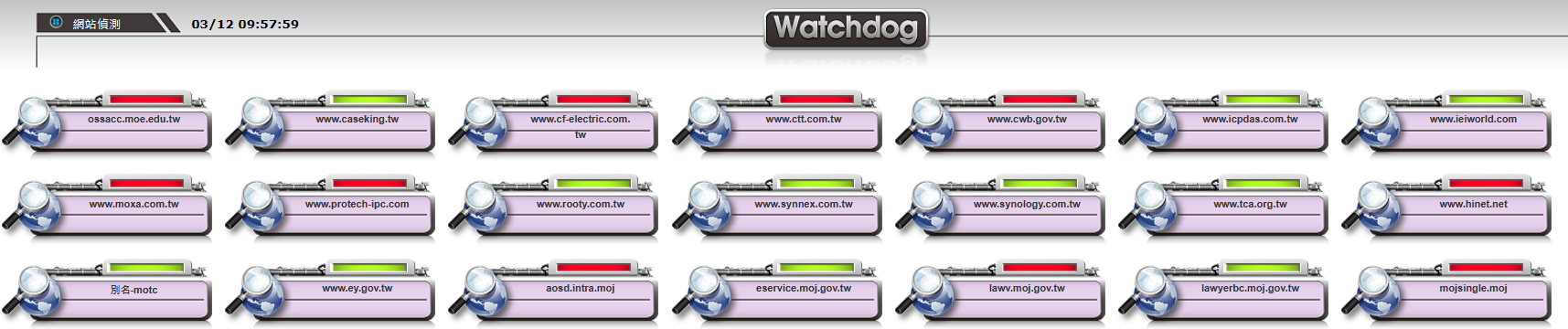
Monitoring Items of Website Monitoring
➢Directly obtain webpage data to determine if the website is interrupted, including:
➥Network and DNS resolution
➥WEB Server (e.g., Apache, IIS)
➥Middleware (e.g., Java AP)
➥Backend Database
➥Webpage Load Time
➢Monitoring targets are URLs and webpage parameters
➢Alert condition is set to website response code
➢Real-time information includes data, alert release, and recovery time
➢Website Certificate Expiry Date - Notify before expiry
➢Source Code Comparison - Prevent webpage tampering
Click the image below to view text-based website monitoring details
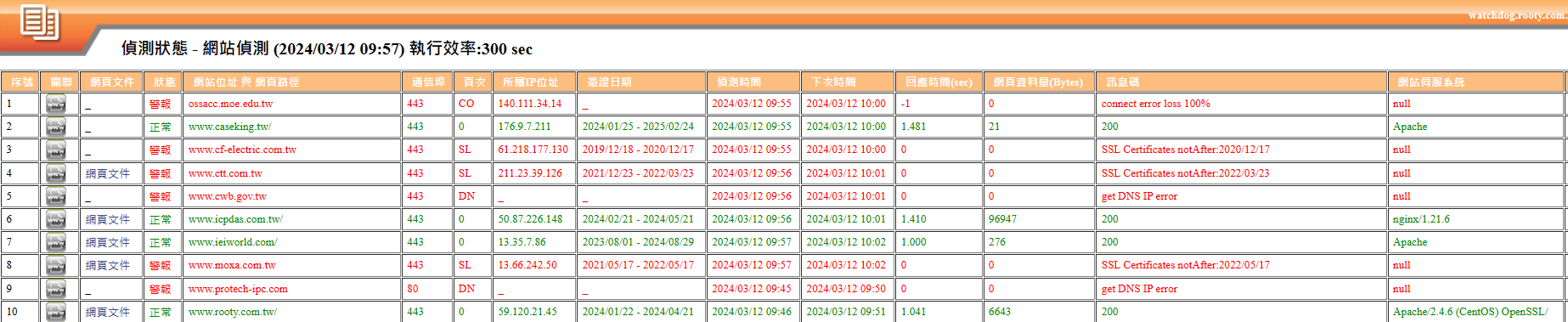
The main focus of website monitoring is on the accessibility, load time, and source code comparison of the webpage to ensure smooth operation and immediate notification of any abnormalities, allowing administrators to obtain and fully grasp the situation at the first time.
Comprehensive Detection Mechanism of Website Monitoring
Using 【Website Monitoring】 to automatically retrieve webpage data enables a complete detection mechanism for the entire data flow.
From the user's computer -> Internet router (Route) -> external network switch (Switch) -> firewall (Firewall) -> internal network switch (Switch),
Load Balancer -> switch (Switch) -> website entry host (middleware host) -> database server (possibly Cluster or HA)
storage devices (Storage such as: NAS, SAN, DAS, iSCSI)
Any anomalies at any node may lead to website service interruption, which is why comprehensive website monitoring is crucial.
Website Monitoring - Alert Settings
In addition to the aforementioned detection information (obtaining website response code, response time, etc.),
further alert conditions can be set for website monitoring to prevent service interruption and tampering of the webpage.
Alerts can use the following conditions as a basis:
➢Website Data Volume - Issue an alert when the obtained webpage data volume is lower/higher than the set data volume.
➢Website Response Time - Issue an alert when the response time for obtaining webpage data exceeds the defined time.
➢Source Code Comparison - Obtain webpage source code for string comparison and issue an alert if discrepancies are found.
➢Certificate Expiry Date - Notify a set number of days before the certificate expiry date.
It should be noted that, due to the logical operations (not and or) involved in 【Source Code Comparison】, it is more complex.
For a more comprehensive understanding and practical application of 【Alert Condition Settings】 and 【Website Monitoring】,
please explore the related details through the 【Website Monitoring - Detailed Function Description】 link.